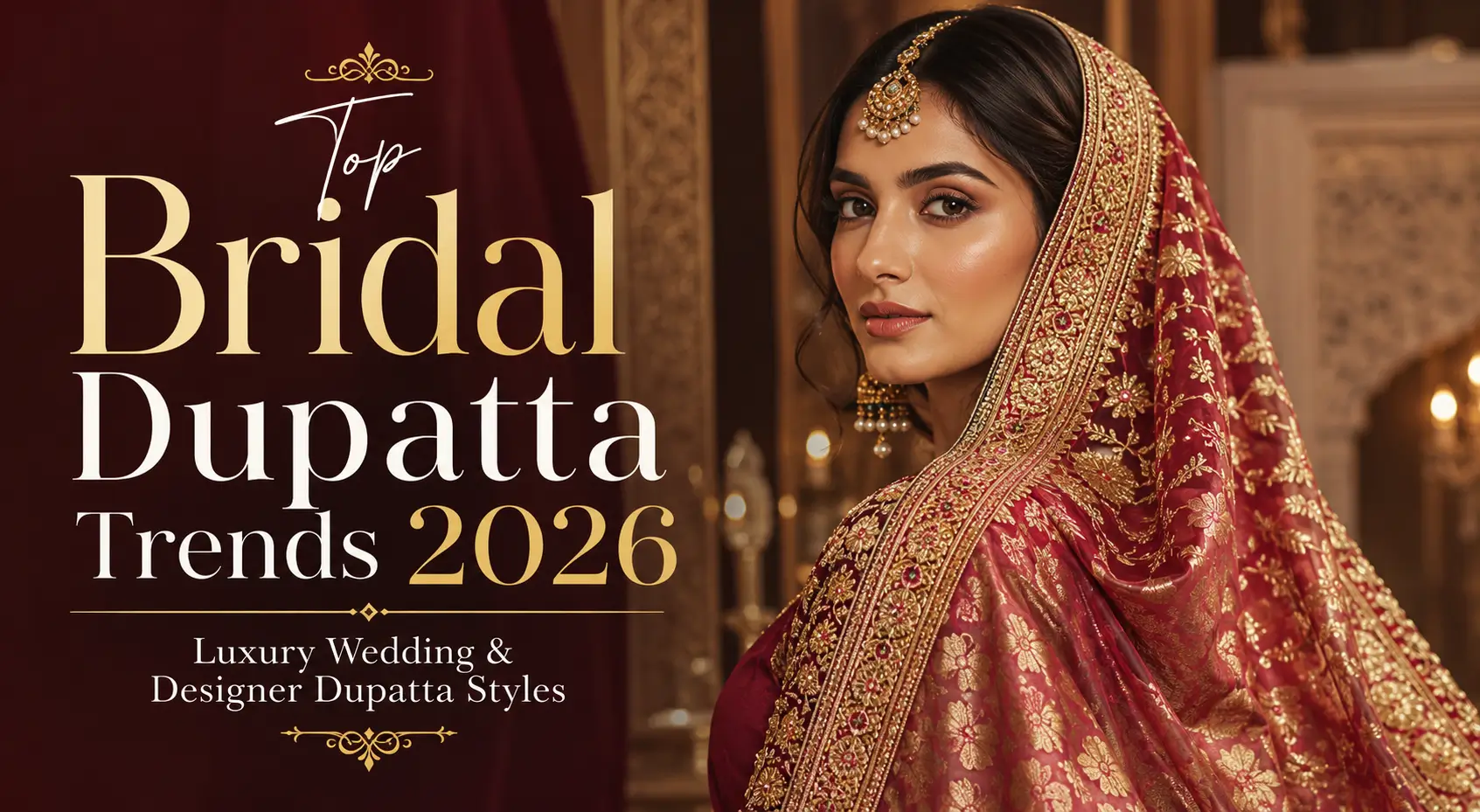
Every bride remembers the moment she found the dupatta. Not just the one that matched — but the one that felt like it was made for her. The one she kept going back to in the browser at midnight, or held up in the store and just knew.
In 2026, the bridal dupatta has quietly become the most considered piece in an Indian bride’s trousseau. Brides shopping for designer bridal dupatta styles online are spending as much time choosing this single piece as they are their lehenga. And honestly? That makes complete sense.
Whether you’re a bride finalising your wedding look, a boutique owner building your bridal collection, or a fashion lover who simply appreciates beautiful craft — this guide walks you through everything that matters in bridal dupatta fashion this year.
Why Bridal Dupatta Trends Matter in 2026
Indian weddings have always been elaborate, emotionally charged, and exquisitely detailed. But what’s shifted in recent years is how deliberate brides have become — not just about their lehenga or jewellery, but about the dupatta that ties the entire look together.
In 2026, bridal fashion is moving toward a beautiful intersection of heritage and modernity. Brides want pieces that feel rooted in tradition but look unmistakably now. They’re researching bridal dupatta trends online, studying celebrity wedding photographs, and making intentional choices about fabric, craft, and colour.
The dupatta, once selected as an afterthought, now often drives the entire bridal ensemble. More brides are building their outfit around the dupatta they fall in love with first — and that shift says everything about how central this piece has become.
Heavy Handwork Bridal Dupatta Trends
If one trend has truly defined bridal conversations in 2026, it’s the return to heavy, intricate handwork. Brides are actively seeking out dupattas where the craftsmanship is the story — pieces that take skilled artisans weeks, sometimes months, to complete by hand.
Zardozi-embroidered borders remain one of the most requested styles for big wedding ceremonies. The raised metallic thread creates a three-dimensional texture that catches light beautifully and photographs with remarkable depth — exactly what brides want for their wedding album.
Dabka work, where thick twisted thread is couched onto fabric in elaborate patterns, is having a strong revival too. You’ll see it most on deep jewel-toned dupattas — emerald, burgundy, and navy — where the gold or silver thread pops with incredible contrast.
Mukesh work — those tiny reflective spots stitched evenly across the fabric — adds luminosity without overwhelming the base. It’s a quieter kind of luxury, the kind you notice up close, and it works beautifully on silk and organza bases alike.
For brides who want that sense of layered opulence, explore our Bridal Dupatta Collection — each piece is a reflection of India’s finest handcraft traditions.
Banarasi Bridal Dupatta Styles
Few things in Indian textiles carry the weight that a Banarasi dupatta does. Woven on traditional handlooms in the ancient city of Varanasi, these dupattas carry centuries of craft in every thread. And in 2026, they’re being styled in ways that feel entirely contemporary.
What makes Banarasi work distinct is that the pattern is woven directly into the fabric — not printed, not embroidered on top. The warp and weft of the loom create the motif, giving Banarasi its characteristic depth and density. You can see this in the lotus blooms, the paisleys, the fine jaal (lattice) patterns that seem to glow from within when light hits them.
Pure silk Banarasi dupattas with heavy zari borders are the first choice for traditional Hindu wedding ceremonies. For pre-wedding events like mehendi and sangeet, lighter tissue Banarasi weaves in softer colours strike the right balance between festive and effortless.
One of the most beautiful styling trends this season: brides are deliberately choosing a Banarasi dupatta that contrasts with their lehenga rather than matching it. A deep plum lehenga paired with a gold-and-ivory Banarasi dupatta creates a combination that feels regal without looking costume-like.
Discover the full range of Banarasi Dupatta styles at AR Silk Lifestyle — pieces that honour the craft while dressing the modern bride.
Organza Bridal Dupatta Fashion
Organza has been quietly building its case in bridal fashion for a few years. In 2026, it’s firmly arrived.
What makes organza so compelling for brides is its structural lightness. It holds shape without feeling stiff, catches wind without going limp, and moves behind a walking bride with an almost cinematic quality. At an outdoor ceremony or a destination wedding, an organza dupatta becomes its own kind of visual drama.
Embroidered organza is the most desired iteration right now. Fine floral thread embroidery on blush, ivory, or champagne organza gives brides a look that reads as romantic and refined — particularly for morning ceremonies and garden weddings where softer palettes work their best.
Cutwork organza is gaining real ground too. Here, patterns are carefully cut into the fabric itself, creating a lace-like effect that’s architectural, feminine, and deeply luxurious. For brides who lean toward contemporary fashion, cutwork organza paired with a clean silk lehenga is one of the most striking combinations of the season.
Silk organza with a minimal gold border is the choice for brides who want elegance without excess — a single strong line of craftsmanship rather than allover embellishment.
Browse our Organza Dupatta collection to find the style that suits your wedding aesthetic — whether that’s delicate and ethereal or bold and structured.
Celebrity-Inspired Designer Bridal Dupatta Trends
Celebrity weddings have always shaped Indian bridal fashion. But social media has compressed the distance between a high-profile wedding and a shopping cart. A bride wears something remarkable on a Saturday and by Monday, searches for that style have spiked across the country.
In 2026, three looks in particular have moved from celebrity inspiration to mainstream bridal desire:
The Pastel Double Dupatta — One heavily embroidered dupatta worn beneath a sheer, softly-toned second layer. The result is simultaneously grand and gentle. It’s a look that photographs beautifully in both natural and artificial light, and brides love that it can transition from the ceremony to the reception with one dupatta removed.
The Single-Shoulder Statement Drape — Instead of the traditional placement over both shoulders, one end is pinned deliberately at the shoulder and the length falls in a clean, dramatic line. This works especially well with heavy handwork dupattas because the full embroidery is visible rather than bunched.
Florals on the Border and Hair — Bridal dupattas with three-dimensional fabric or real flowers along the edge, then pinned into the hair as part of the look. It creates a seamless connection between the garment and the hairstyle — a detail that feels editorial and personal at once.
Our Designer Dupatta collection brings this level of considered craft to every bride — without the couture wait list.
Best Bridal Dupatta Colors in 2026
Red and gold remain eternal. They will never not be bridal. But the colour conversation in 2026 has expanded considerably, and brides are embracing a much wider spectrum.
Champagne and Gold — Warm, glowing, and universally flattering. This combination bridges the gap between traditional and contemporary and pairs effortlessly with ivory, blush, or deep red lehengas.
Dusty Rose with Silver Thread Work — A favourite for daytime and outdoor ceremonies. The muted femininity of dusty rose with cool silver embroidery feels fresh and unhurried — like quiet confidence.
Deep Emerald — Particularly strong for Muslim and Bengali weddings, but crossing over into all wedding aesthetics this year. Rich green with gold zari border work looks unequivocally regal.
Ivory with Antique Gold — For brides who want softness over starkness. The slightly warm tone of ivory catches light differently than white, and antique gold embroidery adds an heirloom quality that feels genuinely special.
Multicoloured Phulkari-Inspired Embroidery — The Punjab-born tradition of vibrant, contrasting thread work is trending beyond regional boundaries. The joyfulness of Phulkari-style work on a bridal dupatta brings an energy to the look that formal embroidery sometimes can’t.
What distinguishes 2026 bridal colour choices is intentionality. Brides are no longer simply matching — they’re creating a considered colour narrative across every element of their look.
How to Style Bridal Dupatta for Weddings
The same dupatta can tell completely different stories depending on how it’s draped. Here are the styles worth knowing:
Classic Head Drape — Both ends fall over the shoulders from the top of the head. Reverent, traditional, and timelessly right for religious ceremonies. If you’re wearing a heavily embroidered dupatta, this drape gives it the full stage it deserves.
One-Side Pallu Drape — One end is pinned at the shoulder; the rest falls in a pallu arrangement to one side. More dynamic, great for showcasing embroidery, and a cleaner silhouette for photographs.
Belt-Defined Drape — The dupatta is gathered and tucked into a statement waist belt, creating dramatic volume below. Best for receptions and sangeet where the look needs to carry across a large room.
The Double Dupatta — Two dupattas worn simultaneously, a heavier heirloom or embroidered piece beneath a lighter, sheer layer on top. This is ceremonial dressing at its most layered and luxurious.
Your hairstyle matters here too. An elaborate up-do handles the weight of heavier dupattas well. If you’re wearing your hair down or in loose waves, a lighter organza or georgette dupatta will drape with far more grace.
Best Fabrics for Bridal Dupatta in 2026
Fabric determines everything — the drape, the weight, the way embroidery sits, how the piece photographs, and how it feels on the body for a full wedding day. Here’s where each fabric earns its place:
Pure Silk — The undisputed choice for main wedding ceremonies. The natural sheen of silk is unlike anything synthetic can replicate, and its drape has a fluidity that makes every movement look intentional. Our Silk Dupatta collection showcases this fabric at its finest.
Organza — Ideal for brides who want structure with lightness. Works beautifully for outdoor, destination, and daytime weddings.
Georgette — A softly textured fabric with natural movement and flow. Excellent for pre-wedding events and brides who want comfort without sacrificing elegance.
Raw Silk (Matka) — Slightly irregular in texture, earthy in character. Perfect for the bride with an artisanal, handcrafted aesthetic who wants something that feels made rather than manufactured.
Tissue — Semi-sheer with a built-in shimmer, tissue dupattas have a luminous quality that comes alive under evening lighting. A stunning choice for reception and cocktail events.
Tips for Buying Bridal Dupatta Online
Shopping for bridal dupatta online is entirely doable when you know what to look for. Here’s how to shop smart:
Verify the fabric, not just the label. “Silk-type” and “silk-look” almost always mean polyester. Always look for “pure silk” or “100% silk” with the fabric composition clearly stated.
Check measurements against your intended draping style. Standard bridal dupattas run 2.25 to 2.5 metres. If you’re planning a double-drape or a head covering, go longer.
Demand multiple images. A close-up of the embroidery, a full-spread flat lay, and a styled shot on a model — these three together give you the clearest picture of what you’re actually buying.
Ask about natural light photographs. Colours can shift significantly under studio or product lighting. For a bridal purchase, it’s reasonable to ask for a daylight photo before confirming.
Understand what “handwork” means on that listing. Hand embroidery takes considerably longer and looks different from machine work under close inspection. A reputable brand will be transparent about this distinction.
Check the return policy before you commit. Bridal purchases deserve flexibility. You should have time to assess the piece at home, in your own lighting, before making it final.
Look for care instructions. Their presence is a sign the brand cares about the product’s life beyond the sale. Pure silk and heavy embroidery both need specific handling — a quality seller will tell you this upfront.
FAQs
Q1. What is the best fabric for a bridal dupatta?
Pure silk is the first choice for most brides — the natural sheen, the weight, and the way it drapes simply can’t be matched by synthetic alternatives. That said, organza is an outstanding choice for outdoor and summer weddings, and georgette works beautifully for pre-wedding events where you need something comfortable enough to dance in.
Q2. How do I choose a bridal dupatta that works with my lehenga?
You have two strong options: match the dupatta’s base fabric and colour closely to the lehenga for a polished, unified look — or choose a deliberate contrast in colour that picks up tones from the lehenga’s embroidery. The second approach tends to look more considered and editorial, especially when done with intention. Avoid accidentally in-between colours that look like you meant to match but didn’t quite.
Q3. What makes a Banarasi dupatta different from other silk dupattas?
The defining difference is the technique. In a Banarasi dupatta, the design is created by the loom — woven directly into the fabric using interlaced threads, often with real or imitation zari (metallic yarn). In most other silk dupattas, the design is printed or embroidered onto the surface after weaving. This is why Banarasi work has that characteristic depth and density — the pattern lives inside the fabric, not on top of it.
Q4. Are organza dupattas practical for a full wedding day?
More than you’d think. Organza’s slightly stiff structure means it holds its shape even after hours of wear — it doesn’t wilt or get stuck to your lehenga the way some softer fabrics can. For heavily embroidered lehengas, an organza dupatta is often the better choice precisely because it doesn’t compete with the embroidery below.
Q5. Should I wear a heavy handwork dupatta for mehendi or sangeet?
Heavy handwork and zardozi dupattas are best saved for the main wedding ceremony — they’re ceremonial pieces, and they deserve a ceremonial stage. For mehendi and sangeet, a lighter embroidered dupatta in a festive colour (mustard yellow, coral, soft green) lets you move freely, dance comfortably, and still look beautifully put-together.
Q6. What celebrity-inspired dupatta styles are trending for 2026?
The pastel double-dupatta look, the single-shoulder dramatic drape, and floral-edged dupattas pinned into the bridal hair are the three biggest celebrity-influenced trends this year. All three work across traditional and fusion bridal aesthetics, and all three photograph exceptionally well — which is no small consideration.
Q7. How should I store a silk bridal dupatta after the wedding?
Wrap it in clean muslin or unbleached cotton — never plastic, which traps moisture and causes silk to deteriorate. Store it flat or loosely rolled, away from direct sunlight. Adding a small sachet of dried neem leaves or cedar helps protect against insects. If the dupatta has heavy embroidery, don’t fold it along the embroidered sections repeatedly — the thread can stress and break at fold lines over time.
Q8. Where can I buy a genuine designer bridal dupatta online in India?
Look for brands that are specific about their craft — ones that tell you the embroidery technique, the fabric composition, and where the piece comes from. Vague product descriptions are a red flag. AR Silk Lifestyle sources directly from skilled artisans and weavers across India, and every piece in our collection is described with full transparency about fabric and craft.
Conclusion
Some brides know their dupatta the moment they see it. Others take weeks of searching before something finally clicks. Either way, when it’s right — it’s unmistakably right.
The bridal dupatta market in 2026 is rich with options: the timeless grandeur of Banarasi weaves, the allover brilliance of heavy handwork, the romantic movement of embroidered organza, the considered drama of a celebrity-inspired double drape. This is arguably the most exciting moment in modern Indian bridal fashion — where tradition has never been more celebrated and personal expression has never had more room.
At AR Silk Lifestyle, we’ve spent years building a collection that takes both sides of that equation seriously. Every dupatta we offer is chosen for the quality of its craft, the authenticity of its fabric, and its ability to make a bride feel not just dressed, but genuinely, completely herself. We work closely with artisans who carry centuries of Indian textile heritage in their hands — and our purpose is to bring that heritage to brides across the country, through a shopping experience that’s as effortless as the dupattas are beautiful.
Your wedding day is one of the most photographed, most remembered moments of your life. Make sure every piece of it is worth remembering.
Explore the AR Silk Lifestyle Bridal Collection — crafted for the bride who knows the difference.